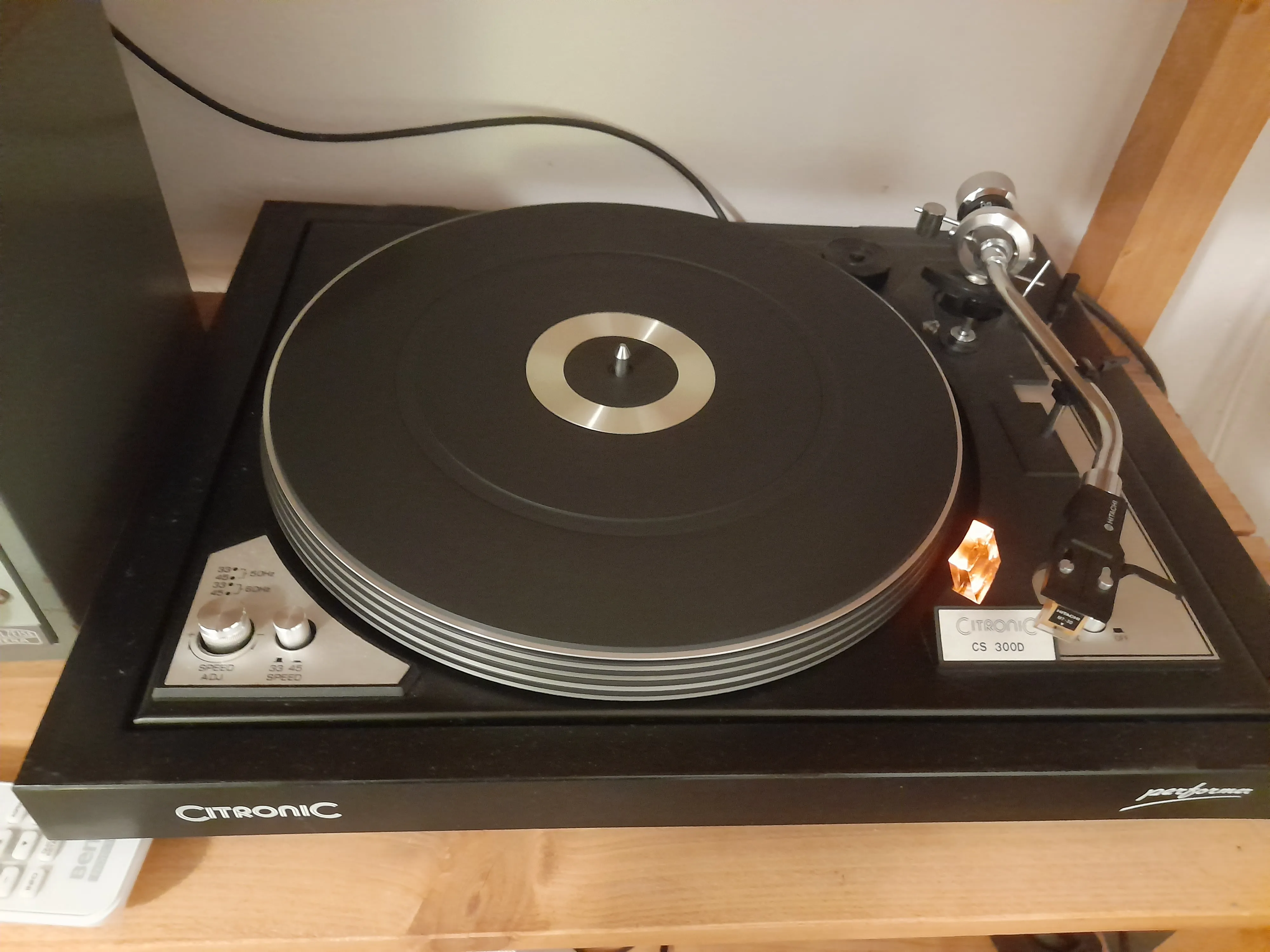
"Everyone's seen a record player…" or "as we all know…" — that's how I planned to start this project. Then I realized that nowadays, not everyone is actually familiar with turntables. I won't go into the relationship between the stylus, the groove, and the rotation — there are plenty of guides for that — but I do want to talk about those little ridges or dots on the side of the platter.
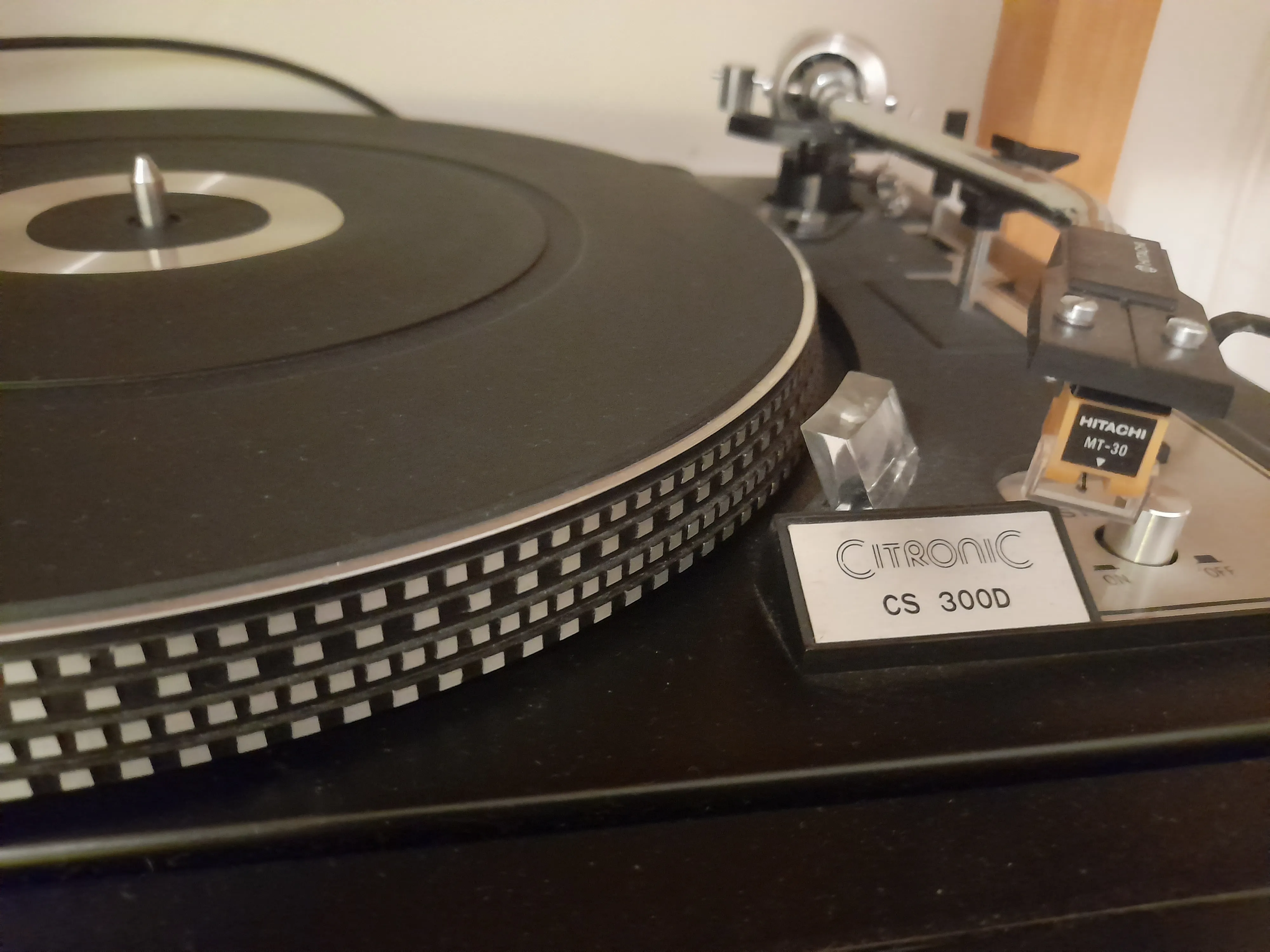
On the side of the platter, you'll often find rows of dots or notches, usually arranged in four rows. Somewhere next to them, there's a tiny lamp illuminating them. This lamp doesn't provide a steady light; it flickers at the rate of the mains frequency in a way that's invisible to the naked eye. Depending on your country, the mains frequency is usually 50 or 60 Hz. A small neon indicator lamp receives this stable signal and flashes on every half-cycle, resulting in 100 or 120 flashes per second.
Standard incandescent bulbs won't work here because they don't cool down fast enough; they stay "on" too long and don't flicker sharply enough. You need gas-discharge or LED lighting. Personally, I think the faint, warm glow of a neon bulb looks the best.
Back to those four rows: depending on your local mains frequency and whether you are playing a 33 ⅓ RPM or a 45 RPM record, you have to watch a specific row. If the platter is spinning at the correct speed (say, 45 RPM), each flash of light catches the notches in the exact same position. To the eye, the notches appear to stand perfectly still. If they drift forward or backward, you need to adjust the pitch/speed potentiometer. When the speed is dialed in correctly, your record won't suffer from wow and flutter (that annoying "drunk" pitch shifting).
Back to those four rows: depending on your local mains frequency and whether you are playing a 33 ⅓ RPM or a 45 RPM record, you have to watch a specific row. If the platter is spinning at the correct speed (say, 45 RPM), each flash of light catches the notches in the exact same position. To the eye, the notches appear to stand perfectly still. If they drift forward or backward, you need to adjust the pitch/speed potentiometer. When the speed is dialed in correctly, your record won't suffer from wow and flutter (that annoying "drunk" pitch shifting).
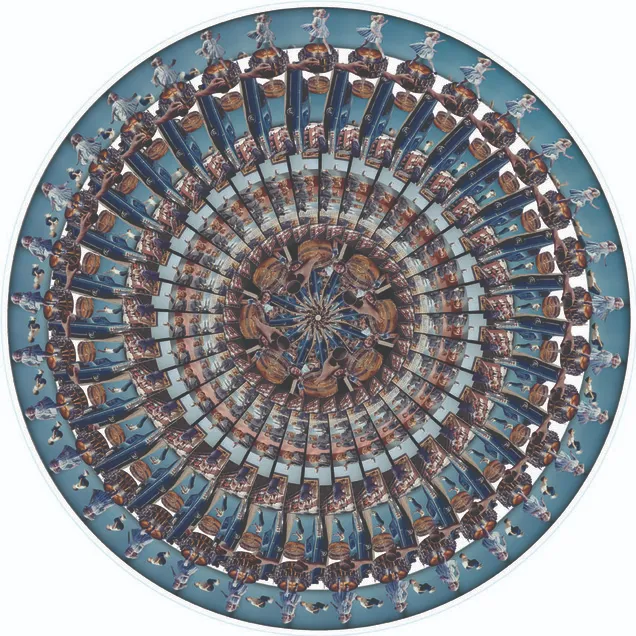
The strobe effect on the platter is a great example of this physics principle, but it's a bit small and not very exciting for a kid. My son was curious, but it didn't really hold his attention. So, I decided to build a proper zoetrope to demonstrate the effect in a much more spectacular way.
Before we dive in, it's worth mentioning that there are some beautiful commercial zoetrope vinyl records out there — special picture discs with animations printed right on the surface. I don't own any yet… but maybe one day if I get enough support on Ko-fi!
Before we dive in, it's worth mentioning that there are some beautiful commercial zoetrope vinyl records out there — special picture discs with animations printed right on the surface. I don't own any yet… but maybe one day if I get enough support on Ko-fi!

I started my own zoetrope by hunting down a simple stickman GIF with a basic animation. This specific GIF consists of only 5 frames. I used ezgif.com to split the GIF into individual frames.
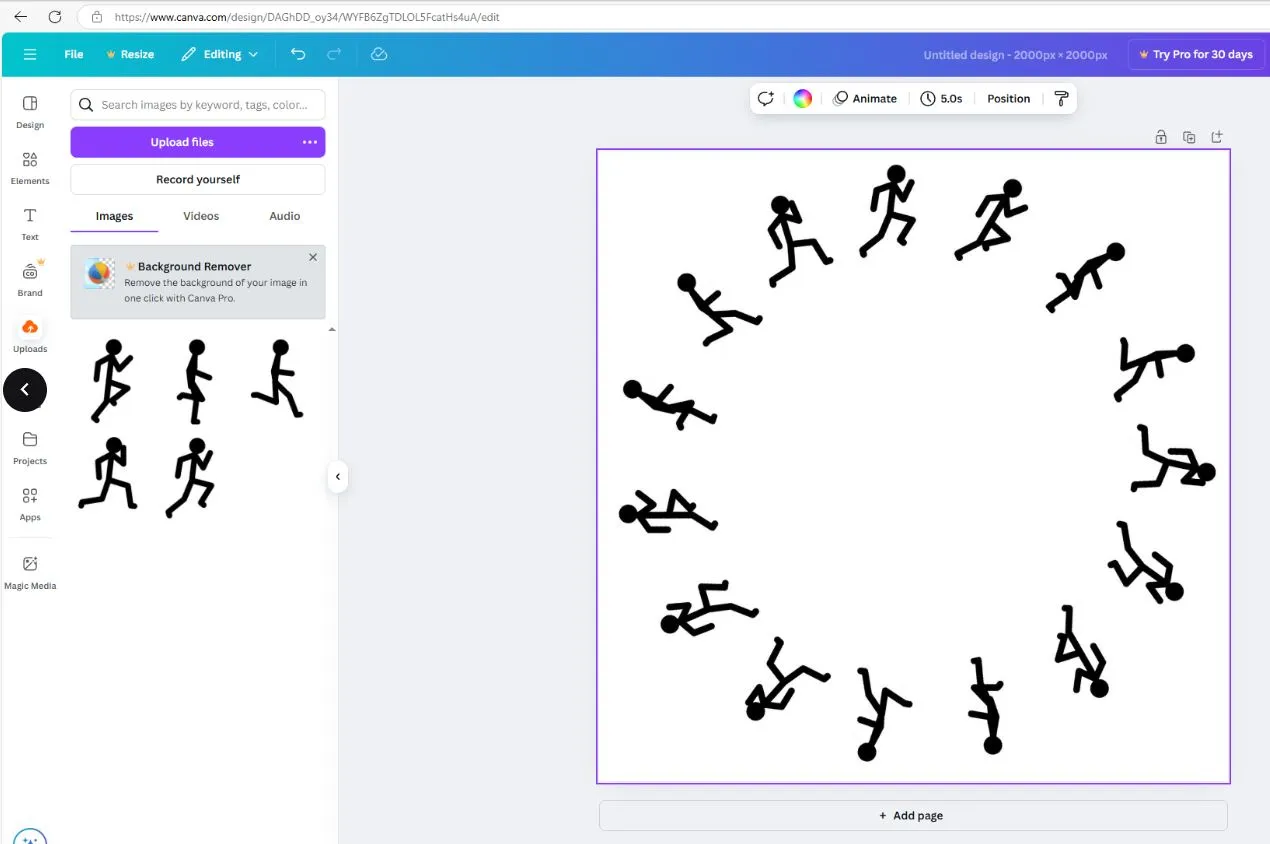
I didn't want to bother with installing heavy software, so I used an online editor called Canva. In just a few minutes, I managed to arrange the 5 frames in a circle, repeating the sequence three times (15 frames total).
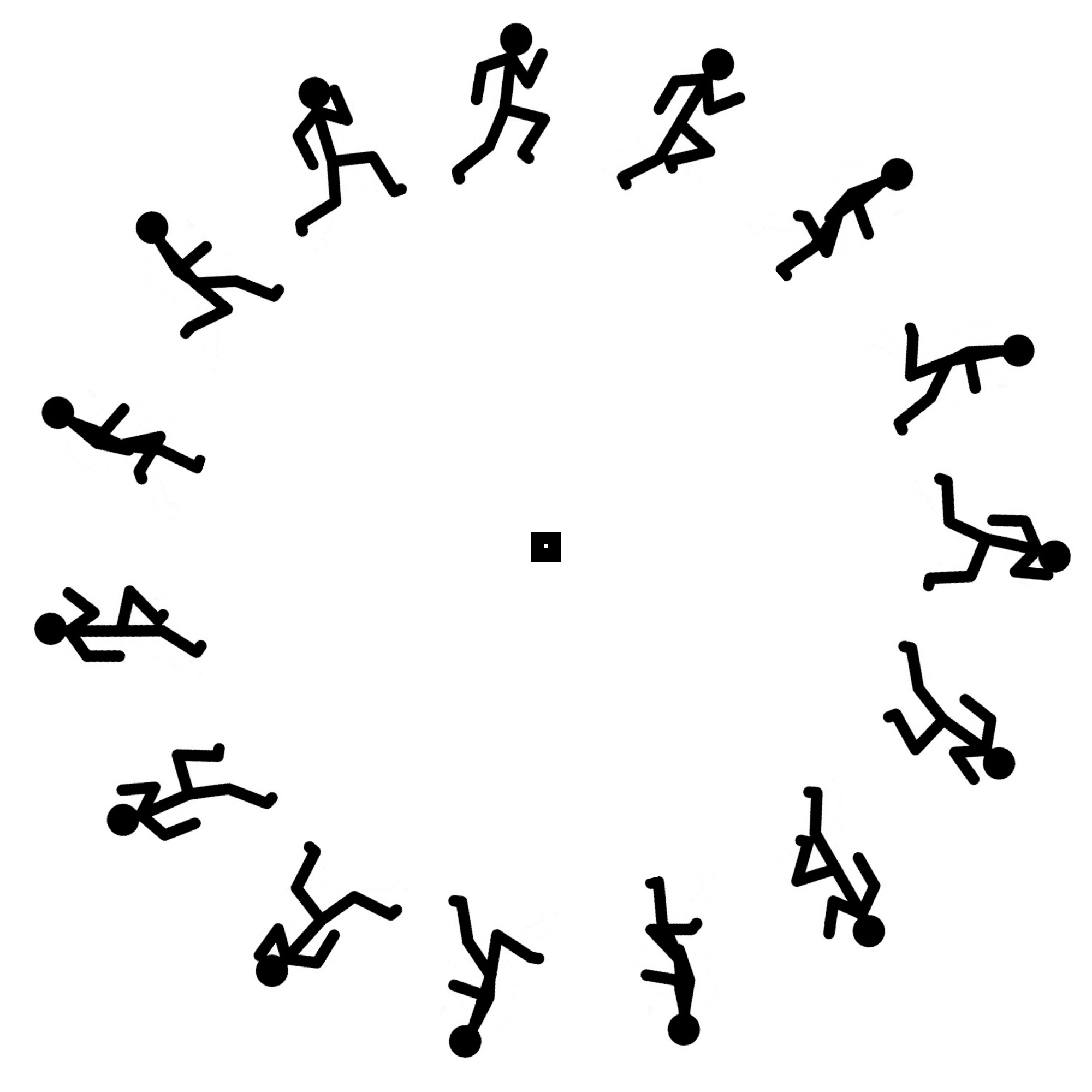
After downloading the design, I marked the center point where I'd need to drill a hole to fit it onto the record player's spindle. And with that, the image was ready. I printed it, punched the hole, and mounted it on the turntable.
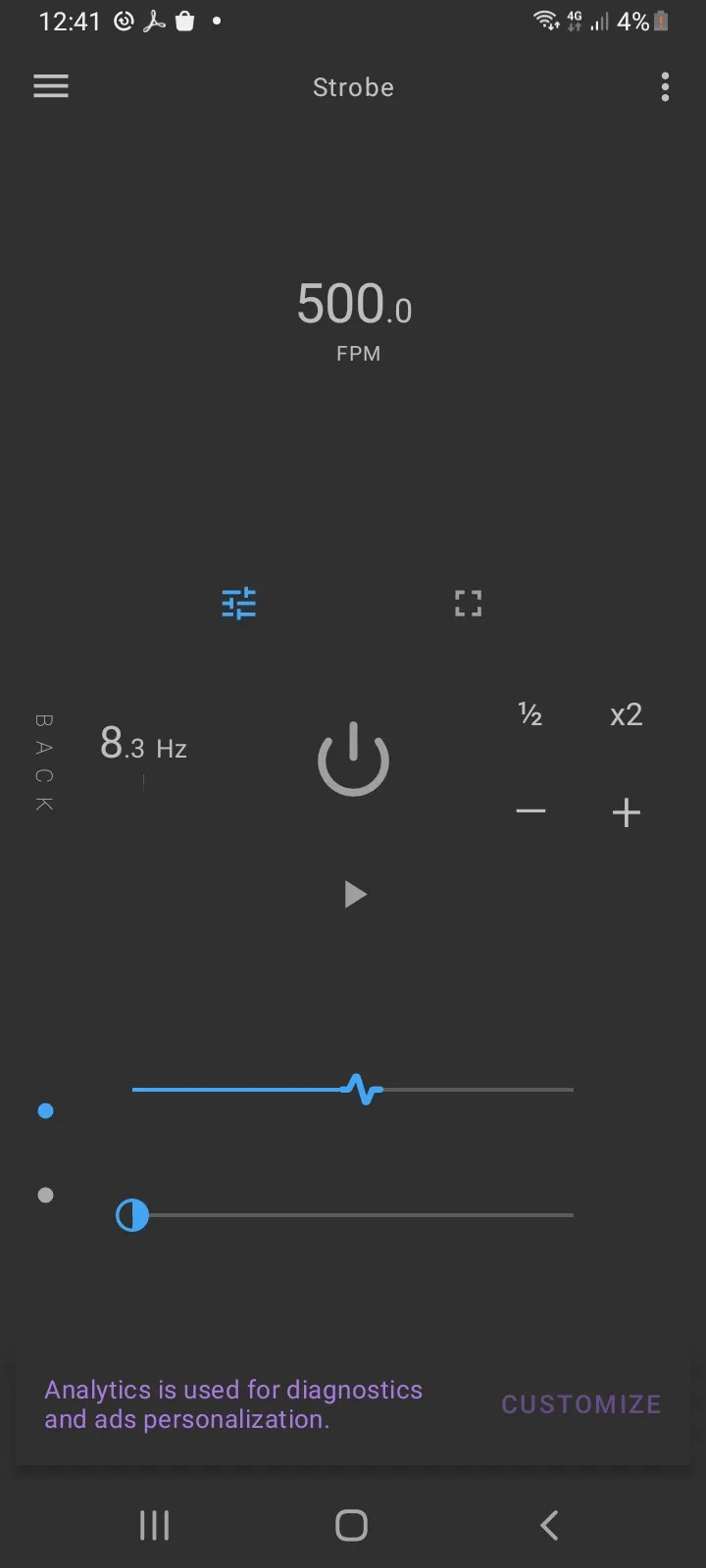
For a zoetrope to work, you need a flickering light — a stroboscope — that flashes exactly when the next frame reaches the correct position. Under normal room lighting, you'd just see a blurry mess as the disc spins. Luckily, there's an app for everything these days. You can use your phone's LED flash as a strobe. I used an app called Strobe:
https://play.google.com/store/apps/details?id=com.zidsoft.flashlight
https://play.google.com/store/apps/details?id=com.zidsoft.flashlight
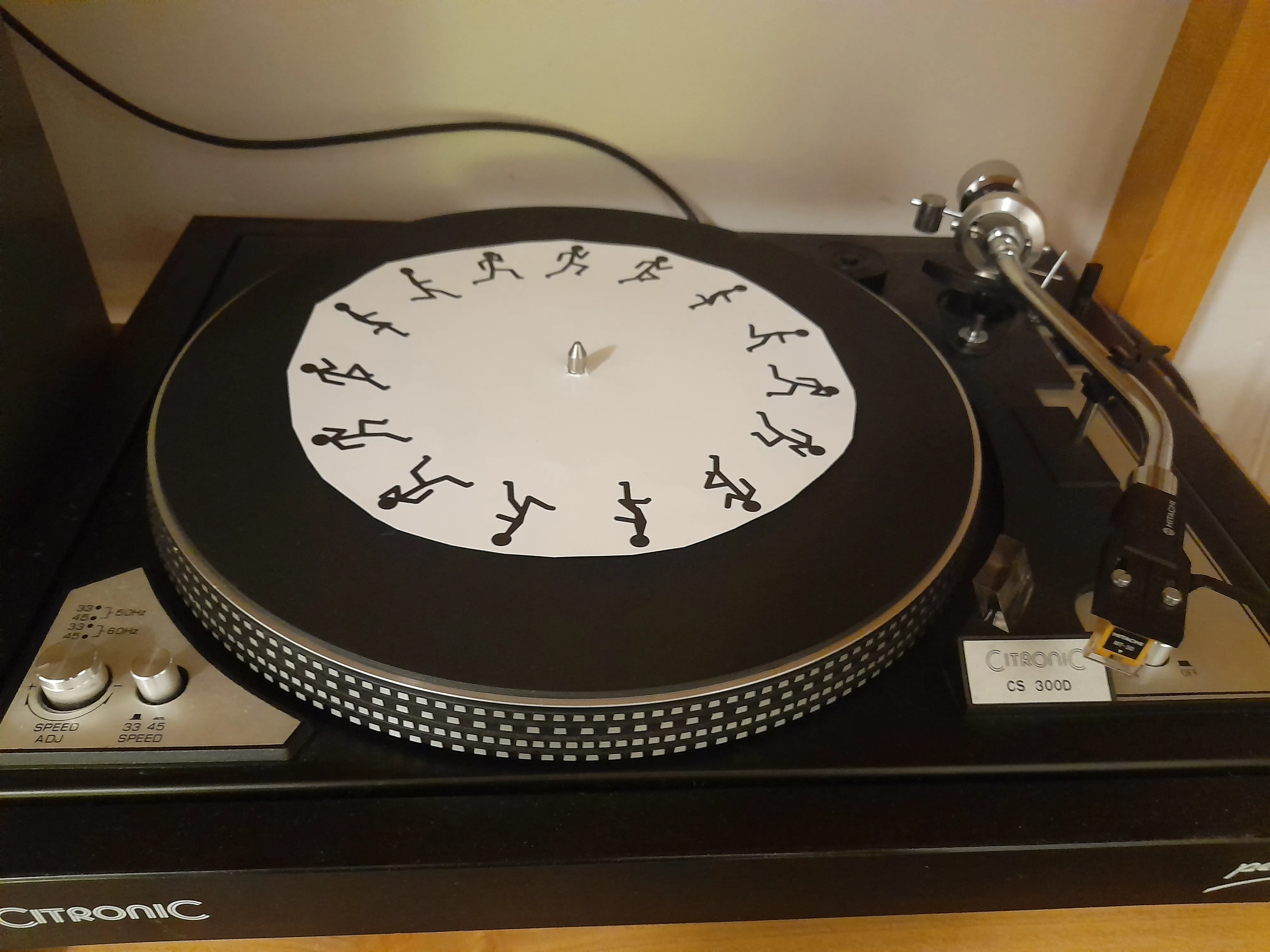
Let's do the math. Suppose we are spinning the disc at 33 ⅓ RPM. That is 33.33 revolutions per minute. Since we have 15 frames per revolution, that equals:
$$33.33 \times 15 = 500 \text{ frames per minute.}$$
If I set the strobe light to 500 flashes per minute (FPM), it will illuminate every single frame in the exact same orientation.
Here's a video of the finished project spinning under the strobe. Photosensitivity warning: if you are sensitive to flickering lights, you might want to skip this one.
I'd call this project a success! My son often asks me to turn on the record player to see the "running man", and I get a chance to talk to him about stroboscopes and how this little figure is essentially tricking his eyes and brain.
I'd call this project a success! My son often asks me to turn on the record player to see the "running man", and I get a chance to talk to him about stroboscopes and how this little figure is essentially tricking his eyes and brain.